

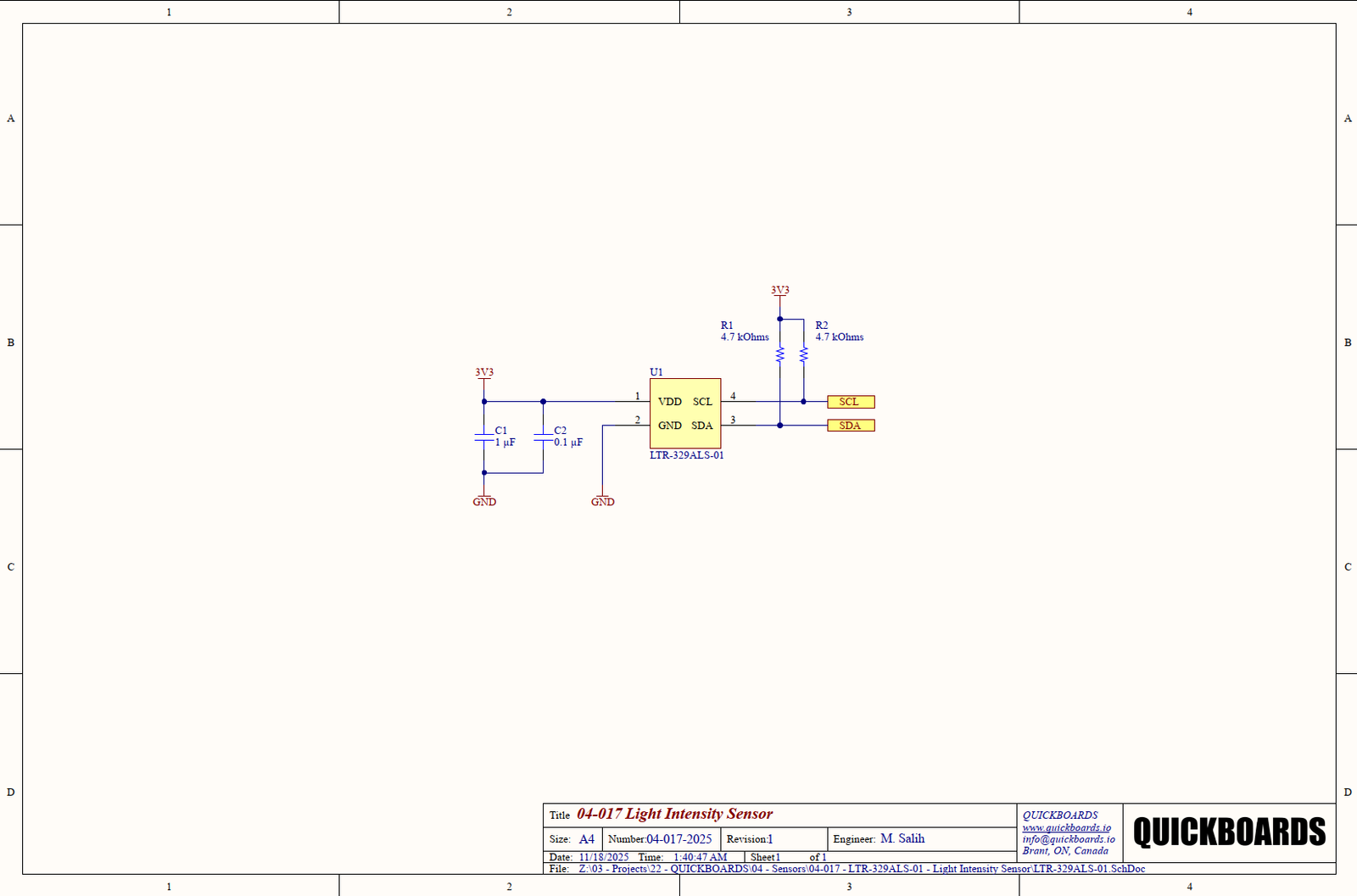
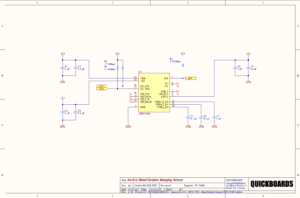
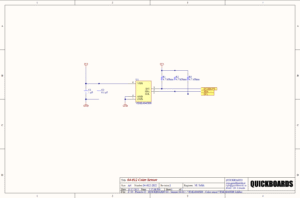
This schematic block features the LTR‑329ALS‑01, a low‑voltage, I²C‑digital ambient light sensor in a miniature 4‑pin VDFN package. It’s designed to measure a wide range of illumination levels with high resolution and low power consumption, making it ideal for portable and display-dimming applications.
The sensor integrates two photodiodes, internal temperature compensation, and an ADC with selectable gain. It provides digital lux readings via I²C, simplifying the interface and removing the need for complex analog front-end design.
Key Features:
- Digital I²C interface (Fast Mode, 400 kbit/s)
- Wide dynamic range: approximately 0.01 lux to 64,000 lux
- Six gain settings (1×, 2×, 4×, 8×, 48×, 96×) for flexible sensitivity
- Close-to-human-eye spectral response with IR and UV immunity
- Flicker rejection (50/60 Hz lighting) built in
- Built-in temperature compensation for stable readings
- Very low active power consumption (~250 µA)
- Ultra-low standby current (~5 µA)
- Supply voltage: 2.4 V to 3.6 V
- Logic-level interface voltage: as low as 1.7 V
- Operating temperature range: –30 °C to +70 °C
Typical Applications:
- Display backlight control (phones, tablets, monitors)
- Ambient brightness sensing in consumer electronics
- Power-saving lighting systems
- Smart home sensors and IoT lighting control
- Environmental light monitoring
- Portable devices that need ambient light feedback
By integrating this Quickboards schematic block, engineers can quickly prototype light-based control systems, reduce analog complexity, and use a compact, power-efficient sensor for reliable ambient light measurement.
| Primary IC | LTR-329ALS-01 |
|---|---|
| IC Datasheet | https://optoelectronics.liteon.com/upload/download/DS86-2014-0006/LTR-329ALS-01_DS_V1.pdf |
| Associated Hardware | HB040172025 |
| Associated Firmware | FB040172025 |
Related products
ZTP-148SRC1 — SENSOR ANALOG TEMP TO46-3
Motion Sensors
ZSBG323671 — ZMOTION PIR SENSOR DUAL ELEMENT
NSL-19M51 — CDS PHOTORESISTOR
Hand Gesture Sensor
APDS-9500 — SENSOR OPT AMBIENT 18 SMD
Carbon Dioxide Sensor
SCD30 — SENSOR CARBON DIOXIDE I2C
Color sensors
VEML6046X00 — SENSOR OPT HIGH ACC RGBIR I2C

Motion Sensors
I3G4250DTR — 3AXIS GYROSCOPE MEMS MOTION SENSOR 16LGA

Current Measurement
SB040082024 – ACS781KLRTR-150U-T 150A CURR SENSOR SCHEMATIC BLOCK
ACS781KLRTR-150U-T — SENSOR CUR HALL 150A 7POWERSMD