

SGX-4OX oxygen sensor reference schematic design
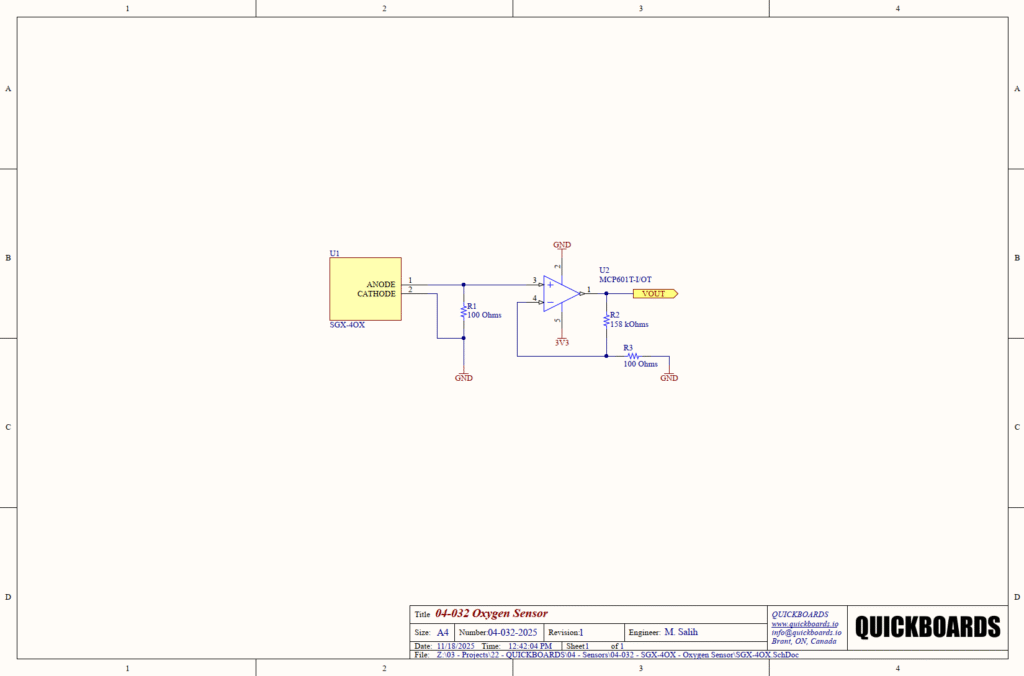
The SGX-4OX is an electrochemical oxygen sensor designed for the detection of oxygen concentration in the range of 0 to 25 percent. Functioning similarly to a galvanic cell, it utilizes a lead-oxygen chemistry to generate a current proportional to the partial pressure of oxygen in the ambient atmosphere. This sensor is a staple in industrial safety equipment, portable gas detectors, and environmental monitoring systems where reliable, long-term monitoring of life-critical atmospheres is required.
Overview of the SGX-4OX
Electrochemical oxygen sensors like the SGX-4OX provide a robust solution for gas detection because they are passive devices that generate their own signal. The sensor consists of a sensing electrode (anode), a counter electrode (cathode), and an electrolyte. When oxygen diffuses into the cell, it is reduced at the cathode, while the lead anode is oxidized. This chemical reaction produces an electrical current that can be measured to determine oxygen levels.
| Technical Specification | Details |
| Measurement Range | 0 to 25 percent O2 |
| Output Signal in Air | 0.06 to 0.15 mA |
| Response Time (t90) | Less than 15 seconds |
| Operating Temperature | -20 to 50 Celsius |
| Pressure Range | 80 to 120 kPa |
| Expected Operating Life | Greater than 2 years |
| Recommended Load Resistor | 100 Ohms |
| Linearity | Linear up to 25 percent O2 |
Pin Configuration and Function Mapping
The SGX-4OX features a simple two-terminal interface. In this modular design, the current generated by the cell is converted into a voltage and subsequently amplified to provide a high-resolution signal to a host microcontroller.
| Pin Number | Primary Function | Secondary / Peripheral Functions |
| 1 | Anode | Positive Signal Output |
| 2 | Cathode | Negative Reference / Ground |
Functional Block Analysis & Design Decisions
Transimpedance Loading and Signal Conversion
Electrochemical sensors are essentially current sources. To measure the signal accurately while maintaining sensor linearity, the sensor must be loaded. Resistor R1 (100 Ohms) is placed across the Anode and Cathode pins. This serves as the load resistor ($R_L$). In electrochemical sensing, the choice of $R_L$ is a trade-off: a lower resistance improves linearity and response time but results in a smaller voltage signal. The 100 Ohm value selected here is the manufacturer-recommended standard, providing an ideal balance for 0–25 percent measurement ranges.
Active Amplification Stage
The voltage across R1 is typically in the millivolt range (e.g., a 0.1 mA output across 100 Ohms yields 10 mV). To bring this into a usable range for a 10-bit or 12-bit ADC, U2 (MCP601T-I/OT) is configured as a non-inverting amplifier. The MCP601 is selected by senior engineers for its rail-to-rail output and, more importantly, its extremely low input bias current (typically 1 pA). Because the source signal is low-level analog, an op-amp with high input impedance is mandatory to prevent loading effects that would skew the sensor’s accuracy.
Gain Rationale and Component Selection
The amplification gain is defined by R2 (158 kOhms) and R3 (100 Ohms). Using the standard non-inverting gain formula, $1 + (R2 / R3)$, the circuit provides a gain of 1581. This exceptionally high gain is designed to resolve minute changes in oxygen concentration. The use of precision resistors for R2 and R3 is necessary to ensure gain stability across different production runs. The 3.3V (3V3) supply at Pin 5 of U2 ensures compatibility with modern low-power logic levels while providing sufficient headroom for the amplified signal.
Placement & Trace Logic
The physical layout of this block is sensitive to electromagnetic interference (EMI). The trace connecting Pin 1 of the SGX-4OX to Pin 3 of the MCP601 must be kept as short as possible. This node carries a low-level millivolt signal; long traces would act as antennas, picking up high-frequency noise from digital switching elsewhere on the PCB. Furthermore, a solid ground plane should be maintained beneath the SGX-4OX and the op-amp to provide a stable reference and minimize return path inductance.
Implementation Insights
A primary engineering consideration for the SGX-4OX is its finite lifespan. Because the lead anode is oxidized during operation, the sensor effectively “consumes” itself over time. System designers should implement a calibration routine in firmware to compensate for the gradual drop in sensitivity as the sensor ages.
Environmental conditions significantly impact performance. While the sensor is temperature-compensated to an extent, rapid changes in ambient pressure can cause transient spikes in the output signal. When integrating this block into an enclosure, ensure the sensor has access to ambient air via a membrane or vent that does not restrict diffusion, but provides protection from direct, high-velocity air currents which can cause “pressure shocks” to the sensing element.
Contamination is a critical factor for electrochemical cells. Exposure to silicone-based vapors, often found in certain adhesives or sealants, can “poison” the sensing membrane and permanently reduce sensitivity. It is essential to use silicone-free materials during the PCB assembly and final product housing phases.
Applications
- Portable Safety Monitors: Compact, handheld devices used by workers to verify safe oxygen levels in confined spaces.
- Industrial Gas Detection: Fixed-point monitoring systems in chemical plants or laboratories to detect oxygen depletion or enrichment.
- Flue Gas Analysis: Monitoring combustion efficiency in industrial boilers and furnaces by measuring residual oxygen.
- Medical Equipment: Verifying oxygen concentration in ventilators or anesthesia delivery systems.
Integrating the SGX-4OX into your design
The SGX-4OX 04-032 modular block provides a production-ready hardware solution for high-precision oxygen sensing. By incorporating a pre-validated loading and high-gain amplification stage, this design eliminates the uncertainty associated with micro-current analog conditioning. This building block ensures that the sensitive electrochemical output is correctly scaled and protected from noise, allowing engineering teams to focus on system-level gas monitoring logic and safety protocols.
Skip the tedious research and manual entry. Download the production-ready schematic block for the SGX-4OX directly from the Quickboards Library.