

SGP40-D-R4 Indoor Air Quality Sensor Reference Schematic Design
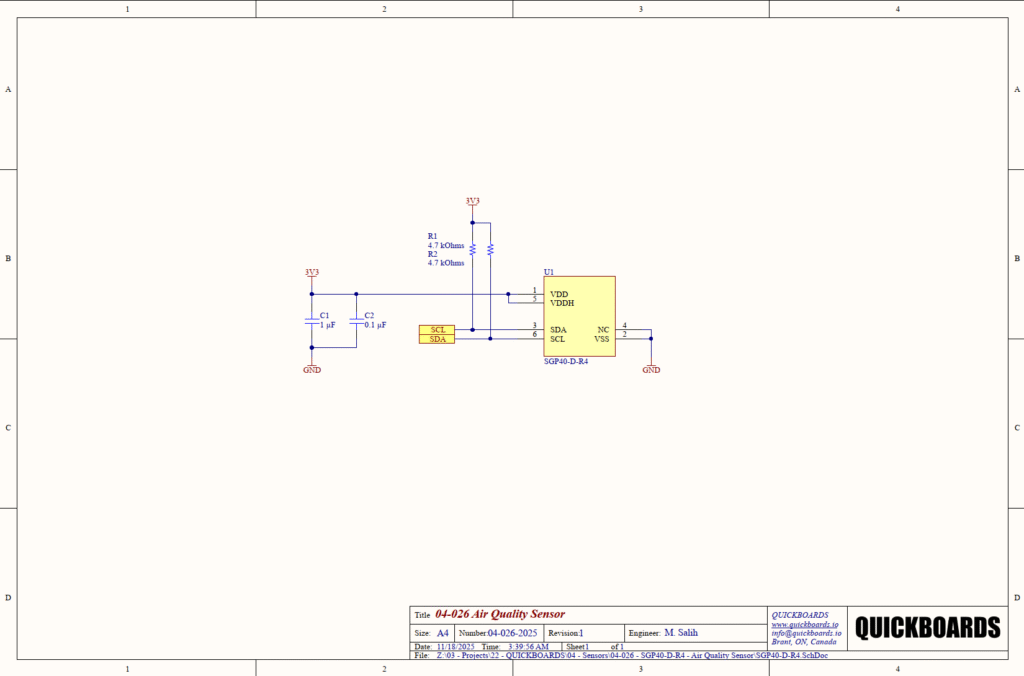
The SGP40-D-R4 is a digital Volatile Organic Compound (VOC) sensor designed for easy integration into air purifiers or demand-controlled ventilation systems. Based on Sensirion’s CMOSens technology, it offers a complete sensor system on a single chip, featuring a digital I2C interface and a temperature-controlled micro-hotplate. Its primary function is to provide a robust VOC signal for indoor air quality applications, which is typically processed by an external algorithm to produce a VOC Index—a numerical value representing the relative change in VOCs in an environment.
The sensor utilizes a metal-oxide (MOx) sensing element. When VOCs interact with the heated sensitive layer, the electrical resistance changes, which the internal electronics convert into a digital signal. This architecture provides outstanding long-term stability and resistance to contamination, making it a preferred choice for long-lifecycle consumer and industrial products.
Overview of the SGP40-D-R4
| Feature | Specification |
| Core Technology | Metal-Oxide (MOx) Multi-pixel |
| Supply Voltage (VDD/VDDH) | 1.7V to 3.6V |
| Interface | I2C (up to 400 kHz) |
| Average Operating Current | 2.6 mA at 3.3V |
| VOC Index Output | 0 to 500 Index points |
| Response Time (t90) | < 2 seconds |
| Device-to-Device Variation | +/- 15 VOC Index points |
| Package | 6-pin DFN (2.44 x 2.44 x 0.85 mm) |
Pin Configuration and Function Mapping
The SGP40-D-R4 is housed in a compact DFN package, requiring careful attention to the thermal and electrical separation of the sensing heater and the digital logic.
| Pin Number | Primary Function | Secondary / Peripheral Functions |
| 1 | VDD | Digital and Analog Supply Voltage |
| 2 | VSS | System Ground |
| 3 | SDA | I2C Serial Data |
| 4 | NC | No Connect (Internally disconnected) |
| 5 | VDDH | Heater Supply Voltage |
| 6 | SCL | I2C Serial Clock |
Functional Block Analysis & Design Decisions
Power and Decoupling Block
The sensor requires power for both the internal logic (VDD) and the micro-hotplate (VDDH). In this reference design, both rails are tied to a common 3.3V supply. To maintain signal integrity and ensure the sensitive MOx measurement is not affected by switching transients, a tiered decoupling strategy is employed. C2 (0.1 microfarad) is a high-frequency bypass capacitor placed as close as possible to the VDD pin to filter out digital noise. C1 (1 microfarad) acts as a localized bulk energy reservoir. This is particularly important for the VDDH rail, as the internal heater cycles current to maintain a precise sensing temperature; C1 ensures that these current pulses do not induce voltage sag on the shared 3.3V rail.
Communication and Interface Block
The digital interface is handled via a standard I2C bus. R1 and R2 (4.7 kOhms) serve as pull-up resistors for the SCL and SDA lines. The choice of 4.7 kOhms is an industry standard for 400 kHz Fast-mode I2C operation in 3.3V systems. It provides a balanced rise time that is fast enough to comply with timing requirements while minimizing static current consumption when the bus is pulled low. For designs with high bus capacitance or multiple devices on the same bus, these values may be adjusted downward to 2.2 kOhms to maintain edge transitions.
Placement & Trace Logic
Physical layout is a primary factor in the performance of gas sensors. The SGP40-D-R4 requires an opening in the enclosure to allow ambient air to reach the sensing membrane. The decoupling capacitors C1 and C2 must be placed within 2 mm of Pin 1 and Pin 5 to be effective. Furthermore, the sensor should be placed away from high-power components (such as microprocessors or power regulators) that generate significant heat. Excessive heat transfer through PCB traces can bias the internal hotplate temperature, leading to errors in VOC detection. Grounding at Pin 2 should be tied to a solid ground plane to provide a low-impedance return path for the heater current.
Design Rationale
The decision to share a single 3.3V rail for VDD and VDDH simplifies the power tree but places a higher burden on the decoupling network. By using ceramic X7R capacitors for C1 and C2, the design ensures stability across the full operating temperature range (-20 to 85 degrees Celsius). Ceramic capacitors are selected for their low Equivalent Series Resistance (ESR), which is vital for filtering the high-frequency noise typical of digital communication environments.
Implementation Insights
A primary engineering consideration for MOx sensors is “burn-in” or stabilization time. After the initial power-up, the sensor requires a brief period for the heater to stabilize the sensing element before accurate VOC Index values are available. Additionally, the VOC Index is a relative measurement; the algorithm requires at least 24 hours of operation to establish a baseline for a given environment.
Contamination is a significant risk factor for the SGP40-D-R4. Siloxanes (silicone-based compounds), which are common in many adhesives and sealants, can irreversibly poison the metal-oxide layer. It is imperative that the assembly process uses “no-clean” solder paste and that no silicone-based potting compounds or adhesives are used near the sensor.
The VOC Index algorithm provided by the manufacturer is not executed on-chip. It must be implemented in the host microcontroller’s firmware. The sensor provides a raw signal via I2C, and the driver (available in C or Python) converts this raw value into the final 0–500 index. Designers must ensure the host MCU has sufficient memory to include these library dependencies.
Applications
- Air Purifiers: Detecting odors and pollutants to automatically adjust fan speed for optimal air filtration.
- Smart Home Thermostats: Providing indoor air quality data to trigger HVAC systems or ventilation fans.
- Kitchen Hoods: Automatically activating exhaust fans upon detection of cooking VOCs.
- Demand-Controlled Ventilation: Optimizing energy efficiency by only ventilating commercial buildings when high levels of VOCs are detected.
Integrating the SGP40-D-R4 into your design
This modular SGP40-D-R4 reference block provides a pre-validated hardware solution for modern air quality monitoring. By utilizing a standardized decoupling strategy and I2C interface, this block eliminates the uncertainty associated with heater supply stability and digital noise. The design ensures that the sensitive sensing element is properly powered and isolated, allowing engineering teams to focus on the high-level integration of the VOC Index algorithm into their system firmware.
Skip the tedious research and manual entry. Download the production-ready schematic block for the SGP40-D-R4 directly from the Quickboards Library.