

MICS-5524 Carbon Monoxide Sensor Reference Schematic Design
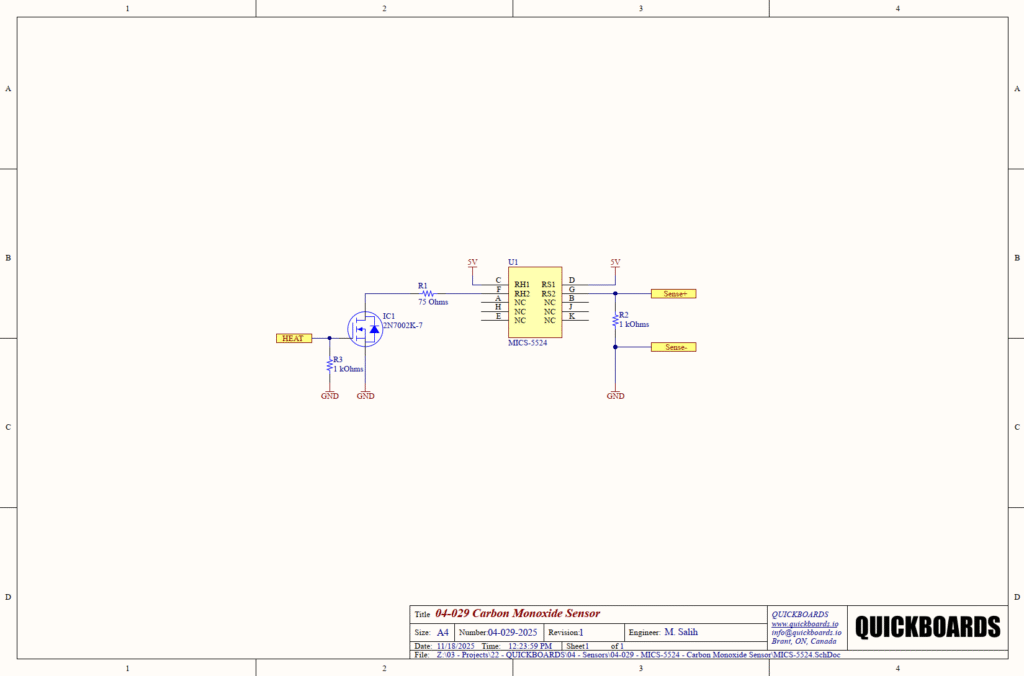
The MICS-5524 is a compact, robust Metal Oxide Semiconductor (MOS) sensor designed for the detection of Carbon Monoxide (CO) and other volatile organic compounds (VOCs). It operates through a micro-hotplate sensing element that changes its electrical resistance when exposed to target gases. This sensor is widely utilized in indoor air quality monitoring, industrial safety equipment, and automotive cabin sensing due to its high sensitivity and miniature surface-mount footprint.
Unlike electrochemical sensors, the MICS-5524 offers a significantly longer operational life and higher resistance to poisoning from common household chemicals. By converting gas concentrations into a measurable analog voltage through a simple voltage divider circuit, it enables engineers to implement hazardous gas detection into cost-sensitive consumer products without the complexity of advanced analog front-ends.
Overview of the MICS-5524
This sensor requires a controlled heating cycle to reach its optimal operating temperature. Once heated, the sensing layer interacts with reducing gases, causing a drop in resistance ($R_s$). This reference design utilizes a 5V supply and an integrated MOSFET switch to manage the heater’s power state, ensuring the sensor can be “cleared” or stabilized before taking measurements.
| Technical Specification | Details |
| Target Gases | Carbon Monoxide, Ethanol, Hydrogen, Ammonia |
| Detection Range (CO) | 1 to 1000 ppm |
| Supply Voltage | 5V DC |
| Heater Current | 32 mA (typical) |
| Heater Power Consumption | 76 mW (typical) |
| Sensing Resistance in Air | 100 kOhms to 1500 kOhms |
| Operating Temperature | -30 to 85 Celsius |
| Package Type | SMD (Land Grid Array) |
Pin Configuration and Function Mapping
The MICS-5524 utilizes a simplified pinout that isolates the high-current heater path from the sensitive signal conditioning path.
| Pin Number | Primary Function | Secondary / Peripheral Functions |
| C | RH1 | Heater Power Supply (5V) |
| F | RH2 | Heater Return / Ground Path |
| D | RS1 | Sensor Resistor Supply (5V) |
| G | RS2 | Sensor Resistor Output (Sense+) |
| A, H, E | NC | No Internal Connection |
| B, J, K | NC | No Internal Connection |
Functional Block Analysis & Design Decisions
Heater Control Block
The heating element is the core of the MICS-5524’s operation. Pin C (RH1) is tied to the 5V rail, while Pin F (RH2) provides the return path. To allow the host microcontroller to control the sensor’s power state, an IC1 N-channel MOSFET (2N7002K) is implemented as a low-side switch. R1 (75 Ohms) is placed in series with the heater return to limit the current and protect the micro-hotplate from over-voltage stress, ensuring the heater operates within its designated power envelope. R3 (1 kOhm) serves as a pull-down resistor on the “HEAT” gate signal, ensuring the heater remains in a safe “OFF” state if the microcontroller pin is in a high-impedance state during startup or reset.
Signal Conditioning and Sensing Block
The sensing circuit is designed as a classic voltage divider. Pin D (RS1) is connected to the 5V supply, and Pin G (RS2) acts as the output node. R2 (1 kOhm) is the load resistor ($R_l$) that completes the divider to ground. As the concentration of Carbon Monoxide increases, the internal resistance of the sensor ($R_s$) decreases, causing the voltage at “Sense+” to rise. The choice of 1 kOhm for R2 provides a balanced dynamic range, ensuring that the analog output remains within a linear region for most common indoor air quality concentrations while preventing the output from saturating under high gas exposure.
Component Selection
Resistor R2 is a critical component for measurement accuracy. It is recommended to use a 1 percent tolerance metal film resistor to minimize gain errors across production units. The 2N7002K MOSFET is selected for its low gate-source threshold voltage, making it fully compatible with 3.3V or 5V logic levels. While not shown in this specific sub-circuit, high-quality ceramic decoupling capacitors (e.g., 0.1 microfarad X7R) should be placed on the 5V rail as close as possible to the sensor to suppress noise generated by the MOSFET switching.
Placement & Trace Logic
Physical layout is vital for gas sensor performance. The MICS-5524 generates heat during operation; therefore, it should be placed away from other temperature-sensitive components like high-precision oscillators or ambient temperature sensors. The trace for “Sense+” should be kept as short as possible to minimize parasitic capacitance and prevent the high-impedance sensing node from picking up electromagnetic interference (EMI). The heater return path through IC1 and R1 should use a solid ground plane connection to minimize ground bounce during the 32 mA switching events.
Implementation Insights
A primary engineering consideration for the MICS-5524 is the stabilization time. Upon power-up, the sensor requires a “pre-heat” period (typically several minutes) to burn off contaminants that may have settled on the sensing layer while the device was off. Software drivers must account for this delay before the “Sense+” voltage can be considered a reliable metric for gas concentration.
Baseline calibration is required for every design. Metal oxide sensors exhibit unit-to-unit variation in their “clean air” resistance ($R_0$). To ensure accuracy, the host system must implement a calibration routine that records the sensor’s baseline resistance in a known environment. Senior engineers should also implement a long-term drift compensation algorithm in firmware to adjust the baseline as the sensor ages or as environmental humidity fluctuates.
Avoid using silicone-based sealants or adhesives near this sensor. Silicone vapors can irreversibly “poison” the metal oxide layer, significantly reducing sensitivity or rendering the sensor non-functional. It is imperative to check the bill of materials for the entire enclosure assembly to ensure no outgassing contaminants are present.
Applications
- Residential CO Alarms: Monitoring air for hazardous carbon monoxide buildup from malfunctioning furnaces, stoves, or car exhaust in garages.
- Smart Home Ventilation: Triggering HVAC fans or air purifiers when elevated levels of VOCs or CO are detected in a living space.
- Automotive Cabin Sensing: Monitoring the air intake of a vehicle to detect exhaust leaks or high levels of external pollution.
- Portable Breathalyzers: Detecting ethanol or other VOCs in handheld diagnostic or safety equipment.
integrating the MICS-5524 into your design
This modular block provides a production-ready implementation of the MICS-5524, eliminating the uncertainty of heater current regulation and signal scaling. By utilizing a pre-validated MOSFET control path and standardized divider network, this design reduces the risk of sensor damage from over-powering and ensures consistent analog output across your product fleet. This reusable sub-system allows engineers to bypass low-level hardware bring-up and focus on the software-level gas concentration algorithms and calibration routines.
Skip the tedious research and manual entry. Download the production-ready schematic block for the MICS-5524 directly from the Quickboards Library.