

ICS-40720 ultra-low noise microphone reference schematic design
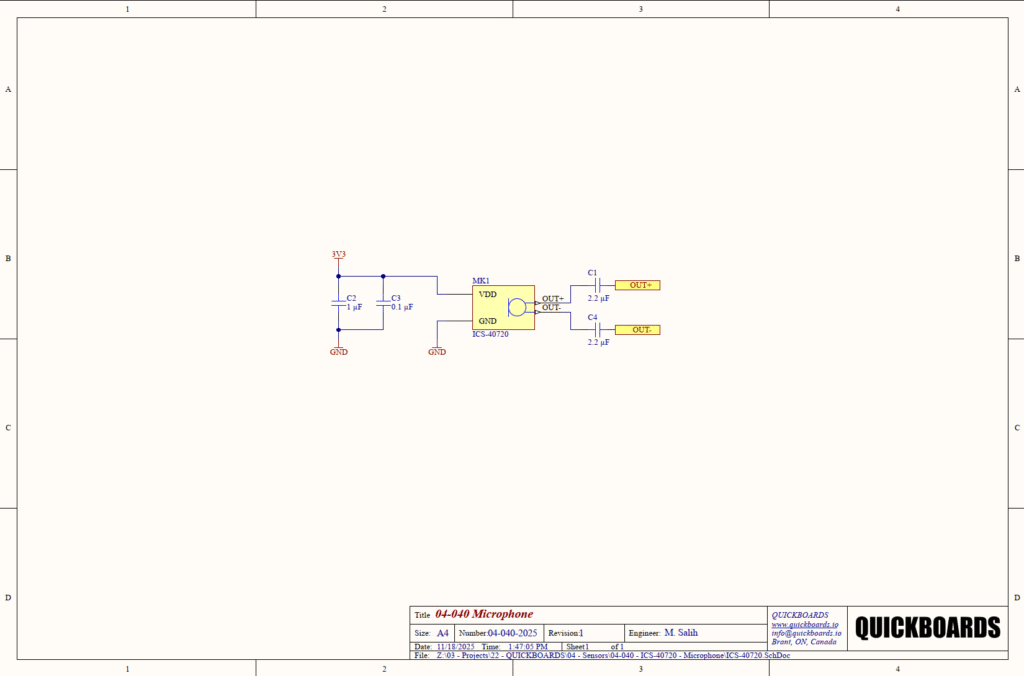
The ICS-40720 is an ultra-low noise, high dynamic range, differential output bottom port MEMS microphone. Its primary function is to capture high-fidelity audio by converting acoustic pressure waves into a differential analog voltage. This integrated circuit is particularly suited for applications requiring high Signal-to-Noise Ratio (SNR) and the ability to handle high sound pressure levels without distortion. Typically found in flagship smartphones, smart speakers, high-end wearables, and professional-grade IoT audio arrays, the ICS-40720 provides a robust analog frontend for high-performance audio systems.
Overview of the ICS-40720
The ICS-40720 consists of a MEMS capacitive sensing element and an impedance-converting amplifier. Its differential output architecture is a significant design advantage, as it provides inherent immunity to electromagnetic interference (EMI) and power supply noise, which is critical in modern, densely packed mobile devices. The device is designed for a flat frequency response across the audible spectrum, ensuring natural sound reproduction.
| Technical Specification | Details |
| Supply Voltage (VDD) | 1.5V to 3.63V |
| Signal-to-Noise Ratio (SNR) | 70 dBA |
| Acoustic Overload Point (AOP) | 124 dB SPL |
| Sensitivity | -38 dBV |
| Supply Current | 285 microamps |
| Output Type | Differential Analog |
| Low Frequency Corner | 75 Hz |
| Package Type | 4.00 mm x 3.00 mm x 1.20 mm Bottom Port |
Pin Configuration and Function Mapping
The ICS-40720 utilizes a streamlined pinout designed for compact surface-mount integration while maintaining the integrity of the differential audio path.
| Pin Number | Primary Function | Secondary / Peripheral Functions |
| VDD | Power Supply | Input Voltage Rail |
| GND | Ground | Common Reference |
| OUT+ | Positive Output | Non-Inverting Differential Audio Signal |
| OUT- | Negative Output | Inverting Differential Audio Signal |
Functional Block Analysis & Design Decisions
Power and Decoupling Block
The ICS-40720 is powered by a 3.3V (3V3) rail. Because high-SNR microphones are extremely sensitive to supply ripples, which can manifest as audible hiss or hum, a dual-capacitor decoupling strategy is employed. C2 (1 microfarad) serves as a localized bulk storage reservoir to stabilize the supply voltage during transient events. C3 (0.1 microfarad) is a high-frequency bypass capacitor, selected for its low equivalent series inductance (ESL) to filter out high-speed digital noise often found on system power rails. Both components are Ceramic X7R types, chosen for their superior capacitance stability across temperature variations. These must be placed as close as possible to the VDD pin to minimize the loop area and parasitic inductance of the trace.
Signal Conditioning and AC Coupling
The output block features a differential signal path (OUT+ and OUT-). To interface this microphone with a following differential amplifier or an Audio Codec ADC, DC blocking is required to prevent the microphone’s internal bias voltage from reaching the next stage. C1 and C4 (2.2 microfarads) are implemented as AC coupling capacitors. The value of 2.2 microfarads is selected to ensure the low-frequency roll-off (high-pass filter) is kept below the audible range, typically calculated based on the input impedance of the downstream amplifier. Ceramic capacitors are used here for their low ESR and compact size, ensuring the audio signal remains transparent and undistorted.
Differential Output Rationale
The choice to utilize both OUT+ and OUT- allows for a fully differential signal chain. This design choice is fundamental for senior engineers aiming to maximize Common-Mode Rejection Ratio (CMRR). Any noise coupled into the audio traces—such as crosstalk from nearby digital buses or RF interference from cellular antennas—will appear equally on both lines and be cancelled out by the differential input of the receiver. This is essential for maintaining the 70 dBA SNR of the ICS-40720 in real-world operating environments.
Placement & Trace Logic
Physical layout is as critical as the electrical schematic for audio performance. The traces for OUT+ and OUT- must be routed as a symmetrical differential pair with matched lengths and consistent impedance to maintain signal balance. Furthermore, the ground pad (GND) must be tied to a solid, quiet ground plane. For bottom port microphones, the PCB must include a precise acoustic hole aligned with the microphone port. Senior designers must ensure the solder mask and paste are controlled to prevent clogging the port, which would severely attenuate sensitivity and frequency response.
Implementation Insights
A primary engineering consideration is the acoustic seal. Even the most perfect electrical design will fail if the mechanical interface between the PCB and the device enclosure is not airtight. Any air leakage around the bottom port will result in a loss of low-frequency response and may introduce acoustic resonance peaks. Using a high-quality acoustic gasket and ensuring flat PCB surfaces is standard practice for high-fidelity capture.
Maintaining a clean VDD rail is paramount. While the differential output provides some immunity, the ICS-40720’s 70 dBA SNR can only be achieved if the power supply noise floor is lower than the microphone’s internal noise. In high-performance systems, using a dedicated, low-noise LDO (Low-Dropout Regulator) to power the audio subcircuit is often required to isolate it from noisy digital rails.
Designers should also account for the startup time of the microphone. When VDD is first applied, the internal amplifier requires a brief period to stabilize its bias. Firmware should implement a short mute period (typically a few milliseconds) to prevent “pop” or “click” sounds from being processed or amplified during the power-on sequence.
Applications
- Smartphones and Tablets: High-fidelity voice capture for video recording and clear communication in noisy environments.
- Smart Speakers and Voice Assistants: Long-range voice pickup and high-accuracy command recognition.
- High-End Wearables: Compact audio capture for smartwatches and hearables where space is at a premium.
- Security and Surveillance: Reliable audio monitoring with high clarity for forensic or analytical purposes.
Integrating the ICS-40720 into your design
This modular block provides a production-ready implementation of the ICS-40720, ensuring that the critical decoupling and AC coupling requirements are met for high-performance audio capture. By providing a pre-validated differential signal path and a standardized power frontend, this design eliminates the uncertainty associated with analog audio integration. This reusable sub-system allows engineers to focus on digital signal processing and acoustic housing while maintaining the highest possible signal integrity at the point of capture.
Skip the tedious research and manual entry. Download the production-ready schematic block for the ICS-40720 directly from the Quickboards Library.