
Inductive Reactance and Admittance Calculator
In alternating current circuits, an inductor opposes changes in current. This opposition is called Inductive Reactance. Unlike a resistor, which dissipates energy as heat, an inductor stores energy in its magnetic field and releases it back into the circuit.
Parameters Explained
- Input: Frequency (Hz): As frequency increases, the magnetic field changes more rapidly, creating a larger back-EMF and higher reactance.
- Input: Inductance (mH): A higher inductance value means a stronger magnetic field and greater opposition to current flow.
- Output: Reactance (X_L): Calculated as X_L = 2pi fL, where f is frequency and L is inductance. It is measured in Ohms (Omega).
- Output: Admittance (B_L): The ease with which an inductor allows AC to flow. It is the reciprocal of reactance (1/X_L) and is measured in Siemens (S).
Design Applications
- RF Chokes: Used to block high-frequency noise while allowing DC or low-frequency signals to pass.
- Speaker Crossovers: Low-pass filters in subwoofers use high inductive reactance to block high-pitched treble from reaching the woofer.
- Phase Shifting: In AC power systems, inductors cause the current to lag behind the voltage by 90°.
Inductor Parameters
Calculated Results
Expand your toolbox
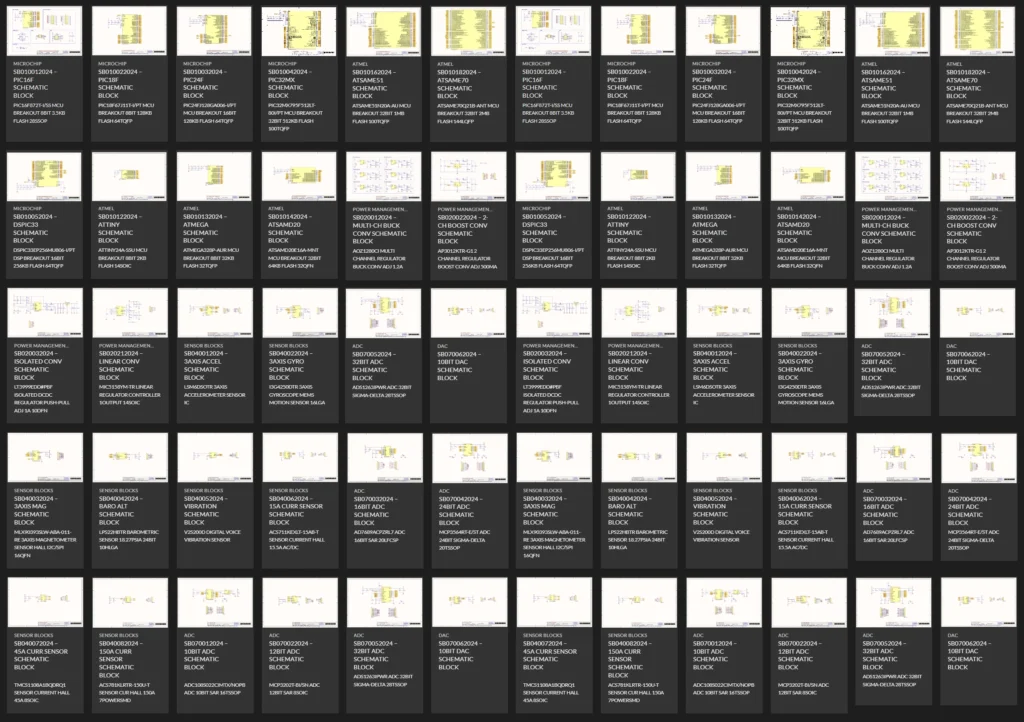
Simplify hardware and firmware development using the Quickboards Library. Eliminate R&D uncertainty and cut design time by assembling subcircuit schematics from a library of Processors, Sensors, Power Management, ADC/DACs, Memory, Interface circuits and more. Download the full library here.