

ZTP-148SRC1 IR Temperature Sensor Reference Schematic Design
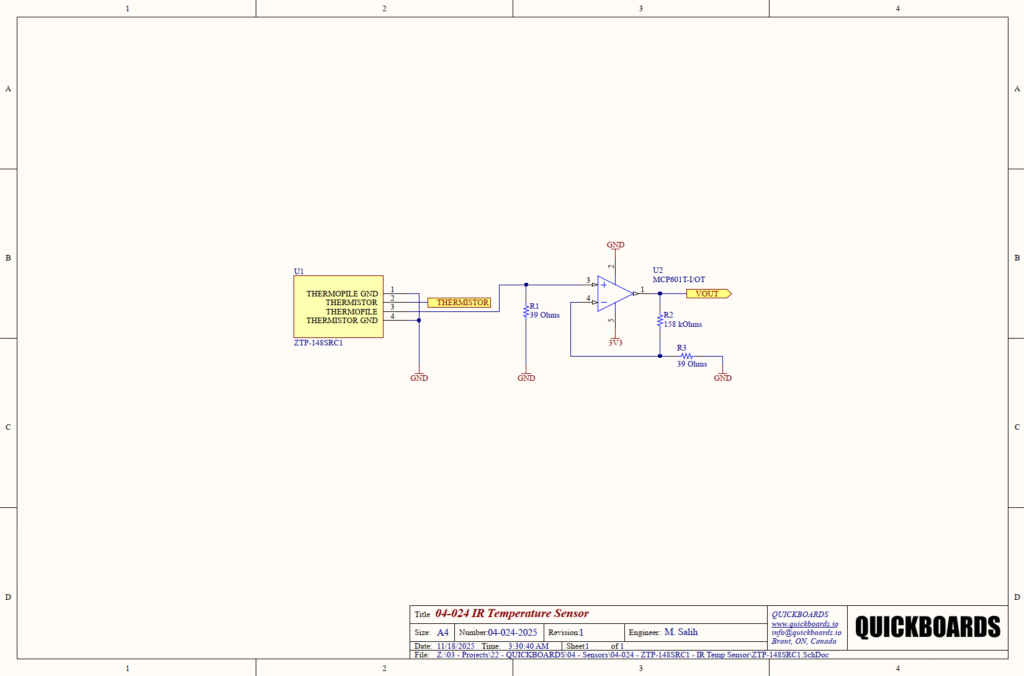
The ZTP-148SRC1 is a thermopile infrared (IR) sensor produced by Amphenol Advanced Sensors, designed specifically for non-contact temperature measurement. It functions by absorbing infrared radiation emitted from an object and converting that thermal energy into a minute analog voltage via the Seebeck effect. This integrated circuit is a staple in medical ear thermometers, industrial pyrometers, and home appliances where contact-based sensing is impractical. To ensure accuracy, the device includes an internal thermistor that measures the ambient “cold junction” temperature of the sensor itself, allowing for precise compensation of the final object temperature calculation.
Overview of the ZTP-148SRC1
The ZTP-148SRC1 is a passive component, meaning it does not require an external excitation voltage for the thermopile element itself. However, because the output voltage generated by the thermopile is in the microvolt range, high-precision signal conditioning is required to interface with modern microcontrollers. This modular block pairs the sensor with an MCP601 operational amplifier to provide the necessary gain and buffering for robust signal processing in diverse environments.
| Feature | Specification |
| Sensor Type | Thermopile (Non-contact IR) |
| Field of View | 85 Degrees |
| Thermistor Resistance | 100 kOhms (at 25 degrees Celsius) |
| Operating Temperature | -20 to 100 degrees Celsius |
| Storage Temperature | -40 to 120 degrees Celsius |
| Internal Filter | Silicon with 5.5 um Long-pass |
| Output Sensitivity | 42 to 60 uV/C (typical) |
| Package Type | TO-46 Metal Can |
Pin Configuration and Function Mapping
The ZTP-148SRC1 utilizes a standard four-pin TO-46 configuration, effectively separating the thermopile output from the ambient temperature compensation element.
| Pin Number | Primary Function | Secondary / Peripheral Functions |
| 1 | Thermopile GND | Common Ground for IR sensing element |
| 2 | Thermistor Output | Ambient temperature sensing (NTC) |
| 3 | Thermopile Output | IR signal voltage output (uV range) |
| 4 | Thermistor GND | Common Ground for thermistor |
Functional Block Analysis & Design Decisions
Signal Conditioning: High-Gain Non-Inverting Amplifier
The primary challenge in IR temperature sensing is the extremely low signal-to-noise ratio at the sensor output. U2 (MCP601T-I/OT) is configured as a non-inverting amplifier to address this. The thermopile output from Pin 3 of U1 is fed directly to the non-inverting input (Pin 3) of the op-amp. The gain of this stage is defined by R2 (158 kOhms) and R3 (39 Ohms). The resulting gain is approximately 4052. This massive amplification is intentional; it scales the microvolt-level signals generated by the ZTP-148SRC1 to a millivolt range suitable for the 10-bit or 12-bit ADC of a 3.3V microcontroller.
Component Selection: Precision and Impedance Matching
The choice of 39-ohm and 158-kohm resistors utilizes precision values to achieve a stable and repeatable gain. R1 (39 Ohms) is placed as a shunt to ground at the input. In high-gain DC-coupled circuits, input impedance management is critical to minimize the effects of input bias currents and electromagnetic interference (EMI). While 39 ohms is an unusually low value for a bias resistor, it effectively damps the high-impedance thermopile node, trading off some signal amplitude for significantly improved noise immunity and stability in electrically noisy industrial or medical environments.
Reference measurement: Cold Junction Compensation
The net labeled THERMISTOR provides access to the internal NTC thermistor. Senior engineers will recognize that a thermopile only measures the temperature differential between the object and the sensor package. To determine the absolute temperature of the target, the host system must measure the voltage across this thermistor (typically via a voltage divider, not shown in this specific sub-circuit) to calculate the “cold junction” temperature. Ceramic X7R or metal film components are recommended for the external divider to match the stability of the ZTP-148SRC1.
Placement & Trace Logic
The physical layout of this block is as important as the component values. The trace connecting U1 Pin 3 to U2 Pin 3 must be kept as short as possible to prevent it from acting as an antenna for 50/60 Hz mains hum or switching noise. Because the gain is so high, even a few millivolts of induced noise on the input trace will saturate the output. Both the thermopile and the op-amp share a 3V3 power rail and solid ground plane to ensure a low-impedance return path, which is vital for maintaining DC accuracy.
Implementation Insights
A primary engineering consideration is the thermal isolation of the sensor. The ZTP-148SRC1 measures IR radiation, but it is also sensitive to heat conducted through the PCB traces. If the sensor is placed near heat-generating components (like power regulators or high-speed MCUs), the internal thermistor will report a higher temperature than the actual ambient air, leading to errors in the final compensated temperature calculation.
Noise management is the second high-level consideration. High-gain circuits (4000x) are extremely sensitive to power supply ripple. While the MCP601 has reasonable power supply rejection, it is advisable to use a dedicated LDO or a robust LC filter for the 3V3 rail powering this block. Using software-based averaging or a digital low-pass filter in the host microcontroller is recommended to further smooth the VOUT signal.
Users should also be aware of the “settling time” of the sensor. Upon power-up or a sudden change in ambient temperature, the TO-46 metal can requires time to reach thermal equilibrium. During this period, the object temperature readings may drift. Implementation of a “ready” delay in the system firmware is a standard practice to ensure data integrity.
Applications
- Non-Contact Medical Thermometers: Providing rapid, hygienic temperature readings for ear or forehead thermometry.
- HVAC System Monitoring: Tracking the temperature of vents or motors without the need for complex wiring or physical contact.
- Industrial Process Control: Monitoring the temperature of moving parts on conveyor belts or high-voltage components where contact is dangerous.
- Home Appliances: Detecting the temperature of cooking surfaces or internal oven walls to improve automation and safety.
Integrating the ZTP-148SRC1 into your design
The ZTP-148SRC1 04-024 IR temperature sensor modular block provides a validated, high-gain signal chain that eliminates the complexity of microvolt-level analog design. By providing a pre-calibrated gain stage and dedicated paths for cold-junction compensation, this block allows engineers to skip the tedious process of gain-staging and noise-reduction research. This reusable sub-system ensures that your non-contact sensing design is stable, accurate, and ready for integration into higher-level data acquisition systems.
Skip the tedious research and manual entry. Download the production-ready schematic block for the ZTP-148SRC1 directly from the Quickboards Library.