

VEML6046X00 Digital RGBW Color Sensor Reference Schematic Design
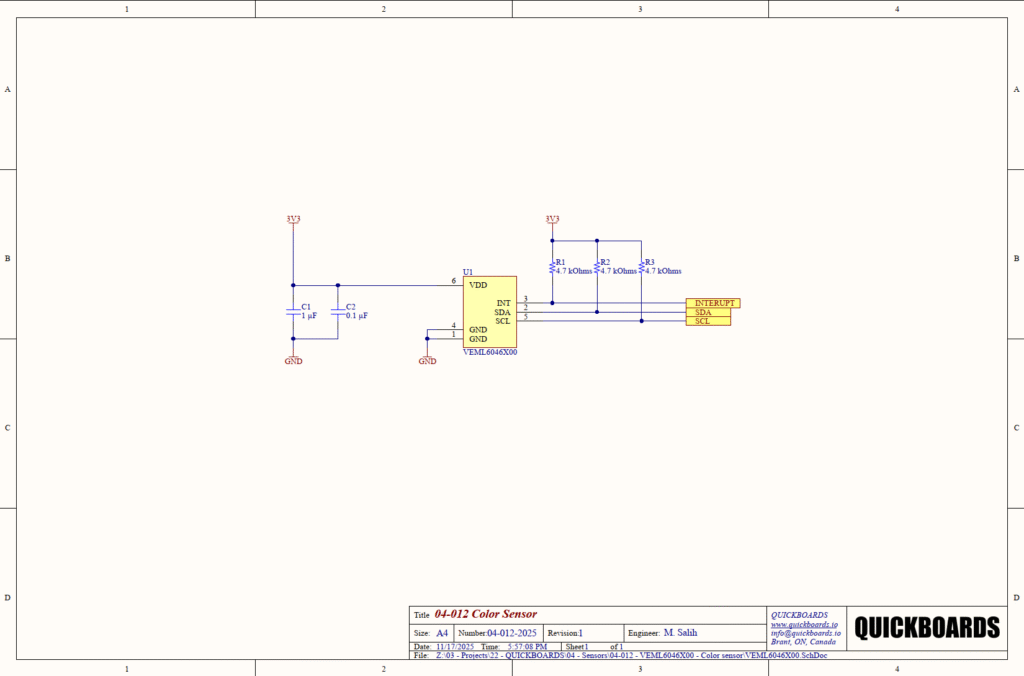
The VEML6046X00 is a high-sensitivity, low-power digital RGBW color sensor that integrates four parallel channels (Red, Green, Blue, and White) with 16-bit resolution into a single CMOS chip. Its primary function is to convert light intensity into digital data that represents the spectral content and illuminance of the ambient environment. This IC is typically utilized in mobile devices for display white balance adjustment, digital cameras for light source detection, and industrial automation for color consistency monitoring. By utilizing Vishay’s proprietary Filtron technology, the sensor achieves a spectral response closely matched to the human eye’s vision, ensuring highly accurate color temperature measurements.
Overview of the VEML6046X00
The VEML6046X00 operates over an I2C interface, allowing for simple integration with standard microcontrollers. It features an excellent temperature compensation capability, maintaining high output stability across its entire operating range. The internal 16-bit ADCs for each color channel allow for high dynamic range, capable of detecting light levels from dark environments to bright sunlight without saturation, provided the integration time is configured correctly.
| Technical Specification | Value |
| Supply Voltage (VDD) | 2.5V to 3.6V |
| Interface | I2C (up to 400 kHz) |
| Resolution | 16-bit per channel (R, G, B, W) |
| Peak Sensitivity | 615 nm (R), 530 nm (G), 460 nm (B) |
| Current Consumption | 170 uA (Operating), 0.5 uA (Shutdown) |
| Temperature Range | -40 to +85 Celsius |
| Package Type | OPTO-6 (2.0 x 2.0 x 0.75 mm) |
Pin Configuration and Function Mapping
The VEML6046X00 is housed in a compact 6-pin surface-mount package. The pinout is designed to facilitate a clean layout by grouping power and ground pins together while keeping the high-speed digital lines on the opposite side.
| Pin Number | Primary Function | Secondary / Peripheral Functions |
| 6 | VDD | Power Supply Input |
| 1 | GND | System Ground |
| 4 | GND | System Ground |
| 2 | SDA | I2C Serial Data |
| 5 | SCL | I2C Serial Clock |
| 3 | INT | Programmable Interrupt Output |
Functional Block Analysis & Design Decisions
Power and Decoupling Block
The VDD supply (Pin 6) is supported by a dual-stage decoupling network consisting of C1 (1 uF) and C2 (0.1 uF). Optical sensors are particularly sensitive to power supply ripple, which can manifest as low-frequency noise in the light measurements. C2 is a high-frequency bypass capacitor, selected for its low equivalent series inductance (ESL) to filter out fast switching noise from the I2C bus and nearby digital logic. C1 provides localized bulk energy storage to stabilize the supply during the sensor’s measurement and integration cycles. Both capacitors should be Ceramic X7R types, as they offer a balanced temperature coefficient and lower voltage derating compared to Y5V or standard electrolytic alternatives.
Communication and Programming Interface
The digital interface consists of the I2C bus (SDA/SCL) and a dedicated hardware interrupt (INT). This reference design utilizes three 4.7 kOhm pull-up resistors (R1, R2, R3) tied to the 3.3V (3V3) rail. The value of 4.7 kOhms is a senior-level design standard for 400 kHz Fast-mode I2C; it provides a fast enough rise time to meet timing specifications while minimizing static power consumption when the bus is pulled low. The INT pin is an open-drain output, allowing the sensor to trigger a host wake-up event based on high/low light thresholds, which is essential for reducing the host’s polling overhead in battery-powered designs.
Placement & Trace Logic
Optical sensors require specific physical layout considerations. Decoupling capacitors C1 and C2 must be placed within 2mm of Pin 6 to ensure effective noise filtering. The digital traces for SDA and SCL should be kept away from high-current switching paths to avoid capacitive coupling of noise. Most importantly, the VEML6046X00 must be placed under a transparent or semi-transparent window in the final device enclosure. The distance between the sensor and the window should be minimized to reduce internal light reflections that could lead to measurement inaccuracies.
Design Rationale
The decision to use a 3.3V rail and 4.7 kOhm pull-ups ensures high compatibility with common ARM Cortex-M and ESP32 microcontrollers. Tying both GND pins (1 and 4) to a solid ground plane is mandatory to minimize internal signal interference and provide a low-impedance return path for the 16-bit ADCs.
Implementation Insights
A primary engineering consideration for the VEML6046X00 is the impact of the enclosure’s optical window. Every material (glass, plastic, acrylic) has a specific transmission spectrum that can attenuate certain colors more than others. Designers should implement a calibration matrix in the host firmware to compensate for the spectral characteristics of the casing to ensure the “true” ambient color temperature is recorded.
Another consideration involves integration time. The VEML6046X00 allows the user to adjust the time the sensor “looks” at the light. Increasing the integration time improves sensitivity in low-light conditions but increases the time between readings. Firmware should be designed to dynamically adjust this integration time based on the detected ambient light level to maximize the dynamic range of the system.
Finally, ensure the I2C bus capacitance is managed. If this modular block is integrated into a system with many other I2C devices or long traces, the total bus capacitance may exceed 400 pF. In such cases, the pull-up resistor values may need to be decreased to 2.2 kOhms to maintain the required signal rise times.
Applications
- Display White Balance Management: Automatically adjusting the color temperature of mobile phone or laptop screens to match the ambient lighting for eye comfort.
- Ambient Light Sensing: Controlling the backlight brightness of instrument clusters and smart home devices to optimize energy efficiency.
- Light Source Detection: Identifying whether the environment is illuminated by incandescent, fluorescent, or LED lighting to adjust camera white balance.
- Industrial Color Monitoring: Ensuring color consistency in manufacturing processes, such as paint mixing or textile production.
- IoT Environmental Monitoring: Real-time logging of spectral data for horticultural or agricultural lighting optimization.
integrating the VEML6046X00 into your design
The VEML6046X00 04-012 color sensor modular block provides a validated, production-ready solution for high-precision optical sensing. By utilizing the pre-tested decoupling and pull-up architecture, engineers can bypass the complexities of I2C bus tuning and supply stability research. This reusable building block ensures that the sensitive 16-bit optical core is correctly supported, allowing design teams to focus on the high-level spectral analysis and calibration required for their specific product enclosure.
Skip the tedious research and manual entry. Download the production-ready schematic block for the VEML6046X00 directly from the Quickboards Library.