

TSSP95038TR IR Detector Reference Schematic Design
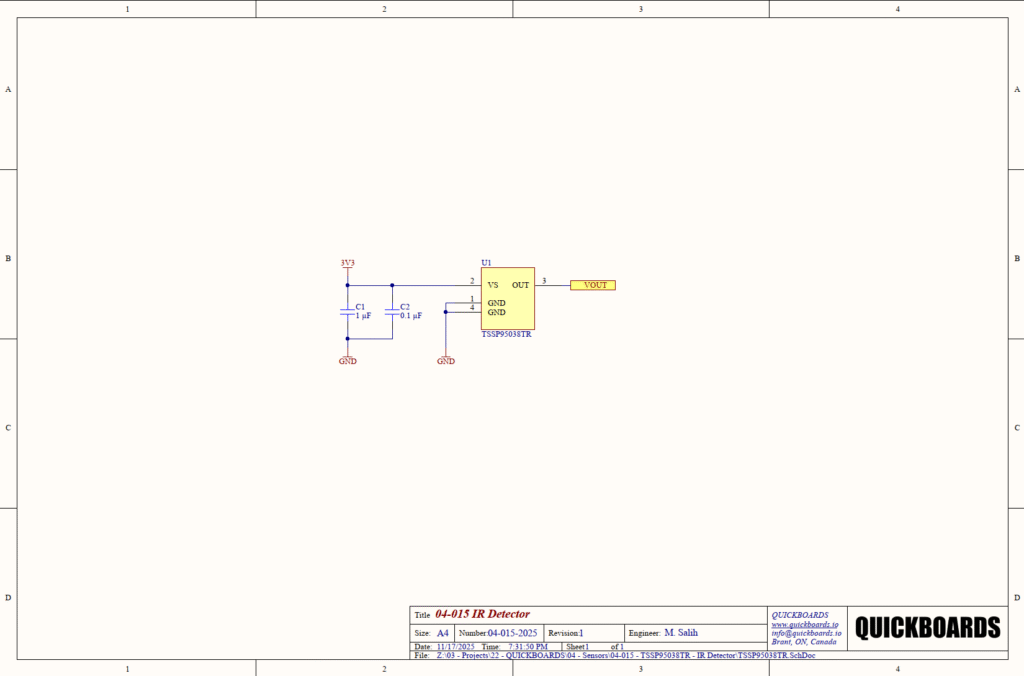
The TSSP95038TR is a compact infrared (IR) receiver module designed specifically for proximity sensing, reflective sensing, and light barrier applications. Unlike standard IR receivers used for remote control data (which employ automatic gain control to handle varying distances), the TSSP series features a fixed gain. This allows the sensor to provide a consistent output pulse width in response to a fixed IR carrier frequency, typically 38 kHz. It is widely utilized in industrial automation for object detection, robotics for collision avoidance, and consumer electronics for touchless switching.
Overview of the TSSP95038TR
The TSSP95038TR integrates a phototransistor, pre-amplifier, and a bandpass filter into a single side-view surface mount package. It is engineered to operate efficiently in environments with high ambient light, thanks to an internal daylight blocking filter. The device provides a digital output that transitions low when a 38 kHz IR signal is detected, facilitating direct interface with microcontroller GPIO pins without the need for complex analog-to-digital conversion.
| Feature | Specification |
| Supply Voltage | 2.0V to 5.5V |
| Carrier Frequency | 38 kHz |
| Supply Current | 0.7 mA (typical) |
| Transmission Distance | Up to 40 meters |
| Output Type | Active Low / CMOS |
| Sensitivity | 0.35 mW/m² |
| Directivity | +/- 45 degrees |
| Spectral Threshold | 940 nm (Peak) |
Pin Configuration and Function Mapping
The TSSP95038TR utilizes a 4-pin configuration designed for high-density surface mount assembly.
| Pin Number | Primary Function | Secondary / Peripheral Functions |
| 1 | GND | Ground Reference |
| 2 | VS | Supply Voltage (3.3V) |
| 3 | OUT | Demodulated Digital Output |
| 4 | GND | Ground Reference / Shield |
Functional Block Analysis & Design Decisions
Power and Decoupling Block
The primary functional block in this schematic is the Power/Decoupling circuit supporting Pin 2 (VS). IR receivers are sensitive to power supply ripples, which can be misinterpreted as valid IR signals, leading to false triggers. This design employs a dual-capacitor strategy using C1 (1uF) and C2 (0.1uF). The 0.1uF ceramic capacitor provides high-frequency bypass filtering to suppress switching noise from nearby digital components. The 1uF capacitor acts as localized bulk storage to stabilize the supply voltage during transient load changes. Both components are specified as Ceramic X7R types for their superior stability over temperature and voltage compared to electrolytic or Y5V alternatives.
Signal Conditioning and Output
The VOUT (Pin 3) delivers a demodulated digital signal to the host system. The TSSP95038TR features an internal pull-up resistor, though external pull-ups (typically 10k to 47k Ohms) are often added in extremely noisy environments to reinforce signal integrity. Because the output is active-low, the default state remains at the VS level until the 38 kHz carrier is sensed. This allows for simple interrupt-driven firmware architectures, reducing the computational overhead on the host microcontroller.
Placement & Trace Logic
Physical layout is critical for optical sensor performance. The decoupling capacitors C1 and C2 must be placed as close as possible to Pin 2 and Pin 1 to minimize parasitic inductance in the power loop. The signal trace for VOUT should be kept short to reduce capacitive loading and minimize the risk of picking up electromagnetic interference (EMI) from high-speed digital buses. Furthermore, Pin 4 must be tied to a solid ground plane; in many packages, this pin serves as an internal shield for the sensitive pre-amplifier, and a low-impedance path to ground is necessary for maximum noise immunity.
Design Rationale
The decision to utilize a 3.3V supply (3V3) aligns with modern low-power microcontroller architectures. By standardizing on 0.1uF and 1uF decoupling values, the design achieves a balance between performance and Bill of Materials (BOM) optimization, utilizing industry-standard values that are likely already present elsewhere in a larger system design.
Implementation Insights
When integrating the TSSP95038TR for proximity sensing, senior engineers must consider optical isolation. A common issue is “optical leakage,” where the IR emitter (not shown) directly illuminates the receiver through the device housing or PCB. Opaque mechanical barriers or light pipes should be utilized to ensure the receiver only reacts to light reflected from the target object.
Ambient light interference, while significantly mitigated by the internal filter, should still be managed. Avoid placing the sensor directly facing high-intensity fluorescent ballasts or windows where direct sunlight might saturate the photodiode. In outdoor applications, a deeply recessed mounting or an additional external IR-pass filter can further improve the signal-to-noise ratio (SNR).
For long-range light barrier applications, ensure the IR emitter is driven with a stable 38 kHz carrier frequency. Any frequency drift in the emitter’s timing source will result in a loss of sensitivity, as the TSSP95038TR’s internal bandpass filter is highly selective to the 38 kHz center frequency.
Applications
- Proximity Sensing: Detecting the presence of a hand or object in touchless faucets, soap dispensers, and paper towel holders.
- Reflective Sensors: Used in robotics for floor detection or wall-following by measuring the intensity of reflected IR light.
- Light Barriers: Creating a “tripwire” for counting objects on a conveyor belt or detecting unauthorized entry through a doorway.
- Object Detection: Implementing basic gesture control or presence detection in smart home devices and kiosks.
Integrating the TSSP95038TR into your design
The TSSP95038TR modular block provides a pre-validated hardware foundation for robust IR sensing. By utilizing a proven decoupling strategy and standardized pin mapping, engineers can eliminate the uncertainty associated with supply-induced noise and signal instability. This building block enables teams to bypass the complexities of analog pre-amplification and move directly to the development of proximity and detection algorithms, ensuring a faster path to a reliable, production-ready product.
Skip the tedious research and manual entry. Download the production-ready schematic block for the TSSP95038TR directly from the Quickboards Library.