

SFA30-D-T formaldehyde sensor reference schematic design
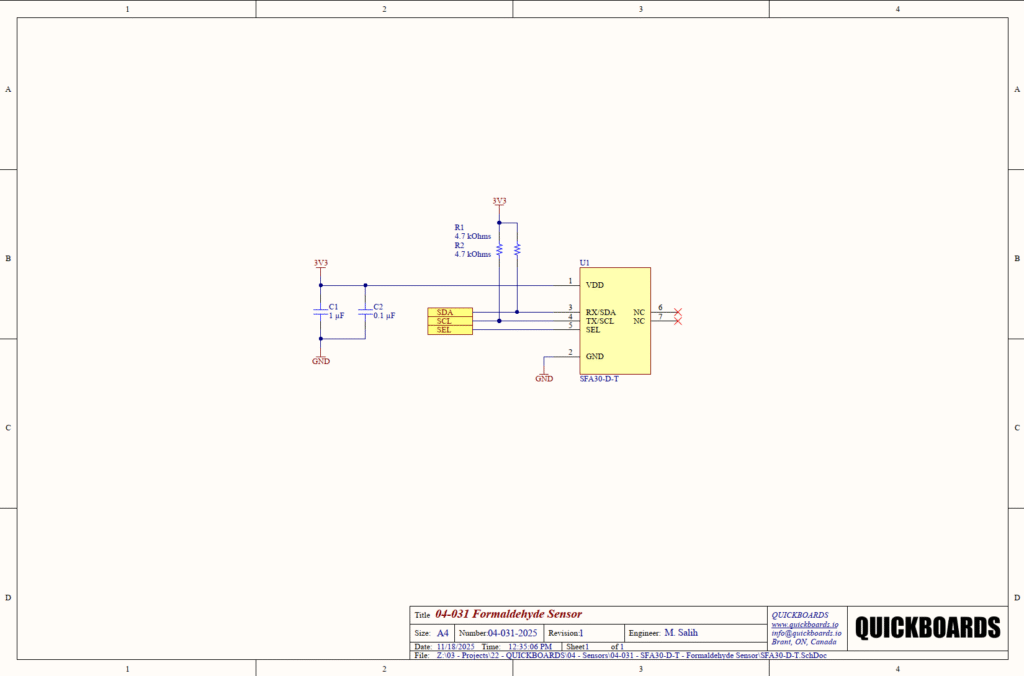
The SFA30-D-T is a high-performance digital formaldehyde (CH2O) sensor module based on Sensirion’s advanced electrochemical sensing technology. Its primary function is to provide accurate, long-term stable measurements of formaldehyde concentrations in indoor environments, which is a critical requirement for modern air quality monitoring. Typically integrated into high-end air purifiers, indoor air quality (IAQ) monitors, and demand-controlled ventilation systems, this sensor addresses the challenge of selective CH2O detection in the presence of other volatile organic compounds (VOCs).
Overview of the SFA30-D-T
This sensor module integrates a specialized electrochemical cell with a high-precision analog front-end and digital signal processing logic. By performing onboard compensation for temperature and humidity, the SFA30-D-T provides a reliable ppb (parts-per-billion) output via standard digital interfaces. This architecture significantly reduces the R and D effort required to implement sensitive gas detection, as the complex chemistry and calibration are managed within the sensor package itself.
| Technical Specification | Details |
| Supply Voltage | 3.135V to 3.465V |
| Measurement Range | 0 to 1,000 ppb |
| Interface | I2C or UART (Selectable) |
| Response Time (t90) | Less than 2 minutes |
| Accuracy | +/- 20 ppb or +/- 20 percent of reading |
| Lifetime | Greater than 6 years |
| Operating Current | 1.0 mA (Active) |
| Output Resolution | 1 ppb |
Pin Configuration and Function Mapping
The SFA30-D-T is designed with a 7-pin interface that facilitates flexible communication protocol selection and robust power delivery.
| Pin Number | Primary Function | Secondary / Peripheral Functions |
| 1 | VDD | Power Supply Input (3.3V) |
| 2 | GND | System Ground |
| 3 | RX / SDA | UART Receive / I2C Serial Data |
| 4 | TX / SCL | UART Transmit / I2C Serial Clock |
| 5 | SEL | Interface Selection (GND=I2C, VDD=UART) |
| 6 | NC | No Internal Connection |
| 7 | NC | No Internal Connection |
Functional Block Analysis & Design Decisions
Power and Decoupling Block
The sensor operates on a 3.3V (3V3) rail, which is critical for maintaining the stability of the internal electrochemical bias. Stability is achieved through a dual-capacitor decoupling network consisting of C1 (1 uF) and C2 (0.1 uF). The 0.1 uF ceramic capacitor is a high-frequency bypass component chosen for its low equivalent series inductance (ESL) to filter out fast switching transients from nearby digital logic or the communication bus. The 1 uF capacitor serves as a bulk energy reservoir, stabilizing the supply during internal measurement cycles where the electrochemical cell and analog-to-digital converter (ADC) active components may induce current spikes. Ceramic X7R capacitors are specified due to their superior stability over temperature and voltage when compared to standard Y5V or electrolytic types.
Digital Interface and Mode Selection
The communication block is configured for either I2C or UART via the SEL pin. In this design, pull-up resistors R1 and R2 (4.7 kOhms) are applied to the SDA/SCL (or TX/RX) lines. For I2C operation, 4.7 kOhms is the industry standard for 400 kHz Fast-mode; it provides a balanced rise time that compensates for bus capacitance without excessive static power consumption when the lines are pulled low. The SEL pin (Pin 5) allows the host system to hardware-select the protocol during boot-up; grounding this pin forces the device into I2C mode, while tying it to VDD enables UART communication.
Placement and Trace Logic
The physical layout of the SFA30-D-T requires careful consideration of the sensing environment. The decoupling capacitors C1 and C2 must be placed in immediate proximity to Pin 1 to ensure a low-impedance path to ground for noise. Digital traces for the communication bus should be routed away from high-current switching rails to prevent inductive coupling. Because this is an electrochemical sensor, the device must be placed such that air can freely diffuse into the sensing membrane on the top of the package. Any mechanical obstruction or airtight enclosure will result in significant measurement lag or incorrect readings.
Design Rationale
The decision to use a standard 3.3V power tree and 4.7 kOhm pull-ups ensures maximum compatibility with ARM Cortex-M and ESP32 microcontrollers commonly used in IoT hardware. Tying the NC pins (Pins 6 and 7) to isolated pads rather than routing signals through them is essential to maintain package integrity and prevent unintended parasitic effects within the IC.
Implementation Insights
A high-level engineering consideration for the SFA30-D-T is the avoidance of siloxane contamination. Electrochemical sensors are susceptible to poisoning from silicone-based compounds found in many adhesives, sealants, and lubricants. It is imperative to verify that no silicone outgassing occurs within the device enclosure, as this will irreversibly damage the sensor’s sensitivity.
Another critical factor is power supply noise. While the sensor integrates its own filtering, excessive ripple on the 3.3V rail can affect the electrochemical baseline. For systems with high-power RF modules (such as Wi-Fi or cellular), it is advisable to use a dedicated low-dropout (LDO) regulator to provide a clean supply for the sensor block to ensure ppb-level accuracy.
The sensor requires a stable orientation for optimal performance. While it is robust against vibration, mounting it in a position where air currents are forced directly into the membrane can cause localized pressure changes that manifest as noise in the formaldehyde signal. A diffusion-based airflow path is preferred.
Applications
- Indoor Air Quality Monitors: Providing real-time ppb-level formaldehyde data for health-conscious smart home consumers.
- Air Purifiers: Enabling automatic fan speed adjustment and filtration logic based on the detection of harmful chemical outgassing from furniture or flooring.
- HVAC Control Systems: Optimizing fresh air intake in commercial buildings to maintain safe formaldehyde levels while maximizing energy efficiency.
- Smart Furniture and Building Materials: Integrating sensing directly into products to monitor VOC and CH2O emissions throughout the product lifecycle.
Integrating the SFA30-D-T into your design
The SFA30-D-T 04-031 formaldehyde sensor modular block provides a production-ready solution for high-precision chemical sensing. By utilizing a pre-validated decoupling strategy and standardized digital interface biasing, this design eliminates the uncertainty associated with electrochemical cell stability and protocol selection. This reusable sub-system ensures that your air quality monitoring design is stable, accurate, and ready for deployment without the need for extensive analog calibration or signal conditioning research.
Skip the tedious research and manual entry. Download the production-ready schematic block for the SFA30-D-T directly from the Quickboards Library.