

ENS210-LQFM Humidity and Temperature Sensor Reference Schematic Design
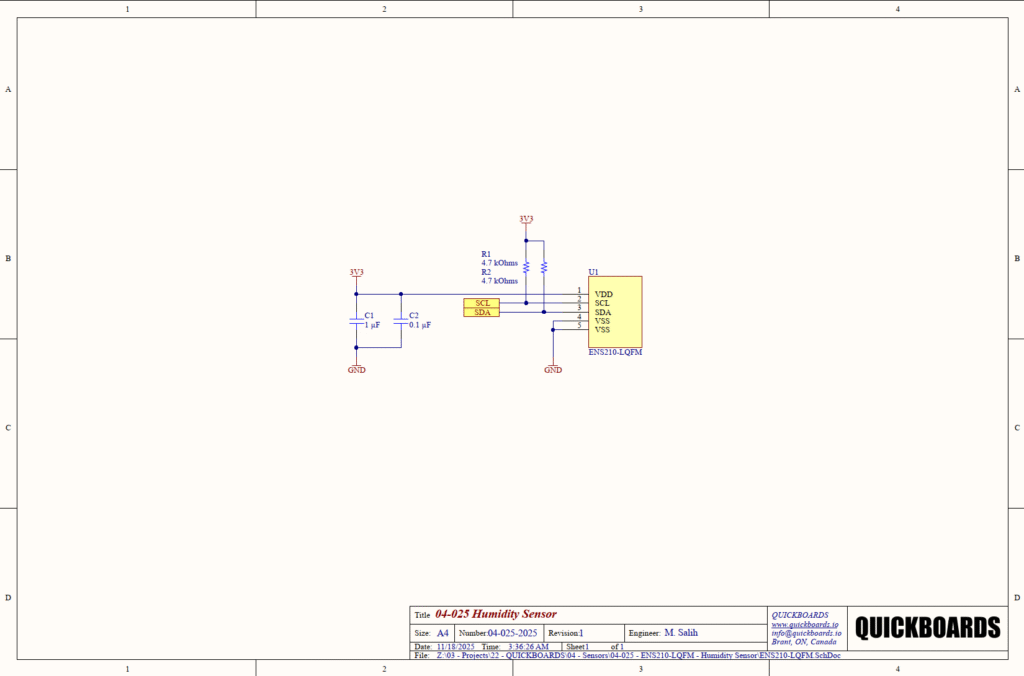
The ENS210-LQFM is a high-performance digital relative humidity and temperature sensor designed for applications requiring high accuracy and low power consumption. It integrates a calibrated sensing element with an analog-to-digital converter and an I2C communication interface in a single monolithic chip. This sensor is commonly used in environmental monitoring systems, HVAC controls, and smart home devices where precise climate data is necessary for system logic or user feedback.
By providing factory-calibrated data directly over a digital bus, the ENS210-LQFM eliminates the need for complex analog signal conditioning or per-unit calibration on the manufacturing line. Its ultra-small footprint and low current draw make it particularly suitable for battery-powered IoT nodes and portable consumer electronics.
Overview of the ENS210-LQFM
| Technical Specification | Value |
| Operating Voltage | 1.71V to 3.6V |
| Temperature Accuracy | +/- 0.2 Celsius (Typical) |
| Humidity Accuracy | +/- 2.0% RH (Typical) |
| Communication Protocol | I2C (up to 400 kHz) |
| Active Current | 40 uA (Typical) |
| Standby Current | 0.04 uA (Typical) |
| Resolution | 16-bit (Digital Output) |
| Package Type | QFN4 |
Pin Configuration and Function Mapping
The ENS210-LQFM utilizes a streamlined 4-pin configuration with an additional ground connection to ensure electrical stability and thermal consistency.
| Pin Number | Primary Function | Secondary / Peripheral Functions |
| 1 | VDD | Positive Power Supply (1.8V to 3.3V) |
| 2 | SCL | I2C Serial Clock Input |
| 3 | SDA | I2C Serial Data Input/Output |
| 4 | VSS | System Ground |
| 5 | VSS | System Ground |
Functional Block Analysis & Design Decisions
Power and Decoupling Sub-circuit
The power block focuses on Pin 1 (VDD), which is tied to the 3.3V (3V3) rail in this design. To ensure the integrity of the internal analog-to-digital conversions, a dual-capacitor decoupling strategy is employed using C1 (1uF) and C2 (0.1uF). The 0.1uF ceramic capacitor is a high-frequency bypass component chosen for its low equivalent series inductance (ESL) to filter out fast switching transients from nearby digital ICs. The 1uF capacitor acts as a localized reservoir to maintain supply stability during the sensor’s measurement bursts. Ceramic X7R capacitors are utilized for their superior temperature stability and lower voltage derating compared to standard electrolytic types.
I2C Communication Interface
The digital interface block includes the SCL (Pin 2) and SDA (Pin 3) lines. This reference design utilizes 4.7 kOhm pull-up resistors (R1 and R2) tied to the 3V3 rail. The 4.7 kOhm value is an industry standard for 400 kHz Fast-mode I2C operation; it provides a fast enough rise time to meet timing specifications while minimizing static power consumption when the bus is pulled low by the master or the sensor. These resistors define the default high state of the open-drain I2C bus, ensuring reliable communication and preventing the pins from floating.
Placement & Trace Logic
Physical layout for the ENS210-LQFM requires specific thermal and electrical considerations. Decoupling capacitors C1 and C2 must be placed within 2mm of Pin 1 to ensure effective noise filtering. Electrically, the digital traces for SCL and SDA should be kept away from high-current switching paths to avoid capacitive coupling of noise. Mechanically, the sensor should be placed away from localized heat sources on the PCB, such as voltage regulators or microprocessors. Since the IC measures ambient temperature via the PCB and its package, placing it near a heat source will result in a measurement offset that does not reflect the actual environment.
Design Rationale
The decision to utilize 1uF for bulk decoupling instead of a larger 10uF capacitor is based on the extremely low operating current of the sensor (40uA). A 1uF capacitor provides more than sufficient energy for measurement cycles while reducing the physical footprint of the sub-system. Grounding both Pin 4 and Pin 5 to a solid ground plane is mandatory to minimize internal signal interference and provide a consistent thermal reference for the sensor.
Implementation Insights
A primary engineering consideration for the ENS210-LQFM is the impact of the enclosure and PCB on the response time. The sensor requires access to ambient air to measure humidity; therefore, the product enclosure must include an opening or vent. To prevent localized heating from the PCB affecting the sensor, designers often use “thermal relief” slots or cutouts around the sensor to isolate it from the rest of the board’s thermal mass.
Another consideration involves contamination during the manufacturing process. The humidity sensing membrane is exposed to the environment and can be damaged by solder flux, cleaning solvents, or conformal coatings. It is recommended to use “no-clean” solder paste and protect the sensor area during the wash or coating phases of PCB assembly.
Finally, manage the I2C bus capacitance. If the sensor is placed far from the host controller or on a bus with many other devices, the 4.7 kOhm pull-up resistors may need to be reduced (e.g., to 2.2 kOhms) to maintain the required signal rise times, though this will increase the power consumption of the bus.
Applications
- Smart Home Automation: Monitoring indoor climate to control smart thermostats, humidifiers, and air purifiers.
- Weather Stations: Providing high-accuracy outdoor humidity and temperature data for meteorological tracking.
- White Goods: Managing moisture levels in refrigerators and washing machines to prevent mold growth or optimize drying cycles.
- Industrial Monitoring: Tracking environmental conditions in warehouses or server rooms where strict humidity control is required.
integrating the ENS210-LQFM into your design
The ENS210-LQFM humidity sensor modular block provides a validated, production-ready solution for high-accuracy climate sensing. By utilizing the pre-tested decoupling and pull-up architecture, engineers can bypass the complexities of I2C bus tuning and supply stability research. This building block ensures that the sensitive 16-bit environmental core is correctly supported, allowing design teams to focus on the industrial design and system-level thermal management required for their specific application.
Skip the tedious research and manual entry. Download the production-ready schematic block for the ENS210-LQFM directly from the Quickboards Library.