

Industry Insights
Why Reference Designs Are Becoming a Core Part of Modern Hardware Engineering
Feb
Rising Complexity and Time Pressure in Electronic Design
Modern electronic systems increasingly combine power management, sensing, processing, and communication subsystems within tight physical, cost, and reliability constraints. As products integrate more functionality, design complexity grows not only at the system level but also within individual circuit blocks, where seemingly small decisions can have system-wide effects. Engineers are often expected to balance performance targets with manufacturability, cost and regulatory requirements from the earliest stages of development.
At the same time, shortened development cycles place sustained pressure on engineering teams to deliver working designs more quickly, often with fewer iterations than in previous product generations. Despite advances in simulation tools and development environments, engineers still spend significant time re-implementing circuits that are already well understood, including power supplies, interfaces, and passives. In practice, reuse is rarely straightforward; differences in operating environments, component availability, and compliance standards can turn familiar designs into new engineering challenges.
Regulatory, safety, and interoperability requirements further complicate early design decisions. A minor oversight in grounding, protection, or signal integrity can propagate through an entire system and lead to costly redesigns later. As a result, hardware development has gradually shifted toward practices that prioritize efficiency, consistency, and risk mitigation alongside innovation.
From Application Notes to Modular Design Practices
Reference designs have long been part of the engineering landscape, traditionally appearing in manufacturer datasheets and application notes as examples demonstrating proper use of specific components. These early resources were typically focused on individual devices rather than complete systems, leaving engineers to adapt and integrate multiple examples into a cohesive design.
As electronic systems became more interconnected, distributors and technical communities began aggregating reference circuits into centralized platforms. These collections improved discoverability but often lacked the structure needed for consistent reuse. Engineers frequently relied on bookmarks, internal archives, or personal libraries of schematics, creating fragmented workflows that varied widely between teams.
In recent years, there has been a gradual shift toward modular design thinking, where commonly used circuit functions are organized into reusable building blocks rather than presented only as full reference boards. This approach mirrors broader changes in engineering methodology, encouraging clearer boundaries between functional subsystems and promoting more systematic reuse of proven circuit topologies.
The Evolution of Reference Designs and Design Reuse
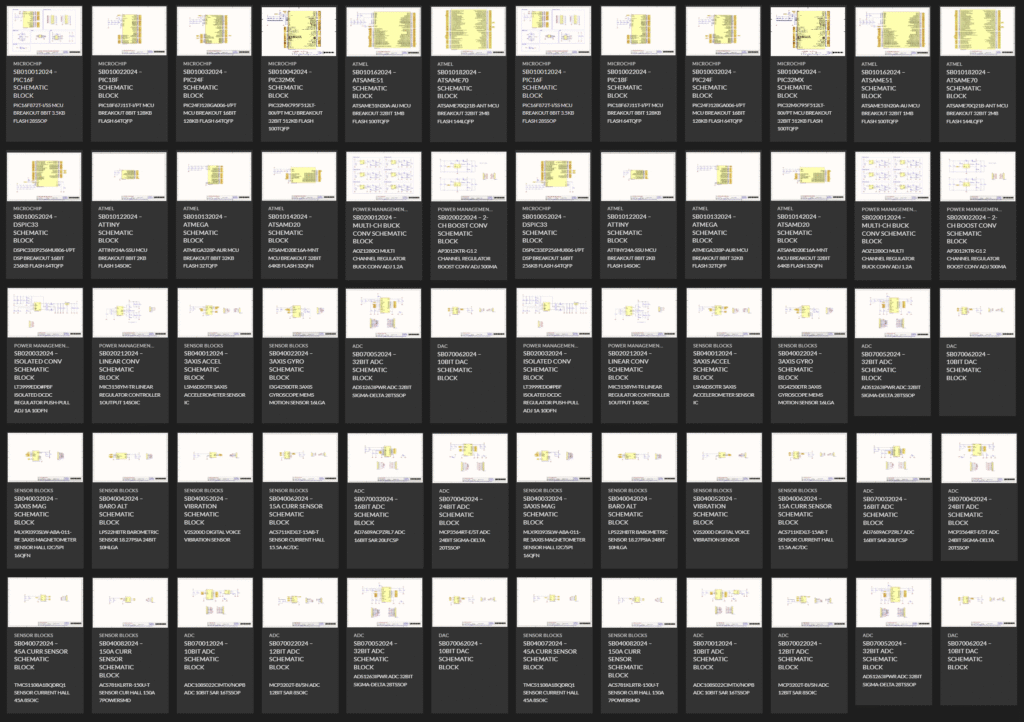
Today, reference designs are accessed through a wide range of sources, reflecting the diversity of modern engineering workflows. Beyond manufacturer application notes, reference designs are now commonly sourced from distributor-hosted platforms such as DigiKey, community-curated repositories like CircuitSnips, and professional schematic libraries structured around modular subcircuits such as Quickboards.
This evolution has been driven in part by the growing complexity of embedded systems. Engineers increasingly need access to validated circuit patterns that can serve as starting points for integration rather than complete, application-specific designs. While centralized repositories improve accessibility, they also highlight the importance of context: a design intended for one environment may not directly translate to another without careful evaluation.
Rather than replacing engineering judgment, modern reference design ecosystems tend to function as accelerators for early-stage development. They provide common ground for collaboration and discussion, allowing teams to focus more on system architecture and less on recreating familiar circuitry from scratch.
Evaluating Reliability and Context in Reference Circuits
Despite their usefulness, reference designs vary widely in reliability and suitability for reuse. Engineers must consider factors such as validation depth, component lifecycle stability, and the assumptions embedded within a design. For example, thermal conditions, load profiles, or electromagnetic compatibility requirements may not be fully documented, leaving critical details open to interpretation.
Clear documentation and well-defined boundaries can help mitigate these risks, but even well-prepared references require technical scrutiny before adoption. Experienced teams often treat reference circuits as starting points rather than finished solutions, adapting them to fit specific project constraints. This process reinforces the importance of engineering context and highlights the difference between reuse as a shortcut and reuse as a deliberate design strategy.
As hardware development continues to evolve, the ability to evaluate and adapt reference designs may become as important as the ability to create new circuits from first principles. The challenge lies in balancing efficiency with a deep understanding of underlying design trade-offs.
Implications for Future Hardware Engineering Workflows
As reference designs become more central to hardware development, their influence on engineering workflows is likely to grow. Systematic reuse can reduce redundant effort, improve consistency across projects, and allow engineers to focus more effectively on system integration and product differentiation. Modular design practices also encourage clearer separation of concerns, supporting collaboration across teams and disciplines.
These trends increasingly align hardware development with practices long established in software engineering, such as libraries, version control, and internal standards. However, an over-reliance on reference designs may limit exploration if not balanced with critical evaluation and customization. The long-term impact of reference-driven design will depend on how thoughtfully reuse strategies are integrated into engineering culture, education, and decision-making processes.
