
ZSBG323671 PIR Motion Sensor Reference Schematic Design
The ZSBG323671 is a dual-element pyroelectric infrared (PIR) sensor designed to detect movement by sensing changes in the infrared radiation (heat) emitted by objects within its field of view. This sensor is a fundamental component in occupancy sensing and automated systems, where it acts as the primary trigger for lighting, security, and HVAC control. By utilizing two sensing elements, the IC can differentiate between ambient thermal changes and actual lateral movement, significantly reducing the occurrence of false triggers in complex environmental conditions.
Develop hardware at the speed of software.
Download this Altium Schematic and hundreds of other subcircuits from the Quickboards library. Design your next board through modular circuit blocks. Each block contains Schematic + PCB Layout + Firmware, built to IPC standards for zero re-spins.
Overview of the ZSBG323671
The ZSBG323671 functions as a passive device, meaning it does not emit energy but rather converts the thermal energy it receives into a minute electrical signal. This signal is typically in the microvolt or millivolt range and requires significant amplification and filtering before it can be processed by a microcontroller. Typical applications include high-sensitivity intrusion alarms, automated warehouse lighting, and smart-home occupancy sensors.
| Technical Specification | Details |
| Supply Voltage (Drain) | 3.0V to 15.0V |
| Element Resolvability | Dual-element |
| Noise Floor | 20 microvolts peak-to-peak (typical) |
| Operating Temperature | -40 to 85 Celsius |
| Field of View | 138 degrees horizontal, 125 degrees vertical |
| Spectral Response | 5 to 14 micrometers |
| Offset Voltage | 0.3V to 1.2V |
| Encapsulation | TO-5 Metal Can with Optical Window |
Pin Configuration and Function Mapping
The ZSBG323671 utilizes a standard three-pin configuration commonly found in TO-5 packaged pyroelectric sensors, separating the power input from the analog signal path.
| Pin Number | Primary Function | Secondary / Peripheral Functions |
| 1 | DRAIN | Positive Supply Input (5V) |
| 2 | SOURCE | Analog Signal Output / Impedance Matching Node |
| 3 | GND | System Ground Reference |
Functional Block Analysis & Design Decisions
PIR Interface and Thermal Detection
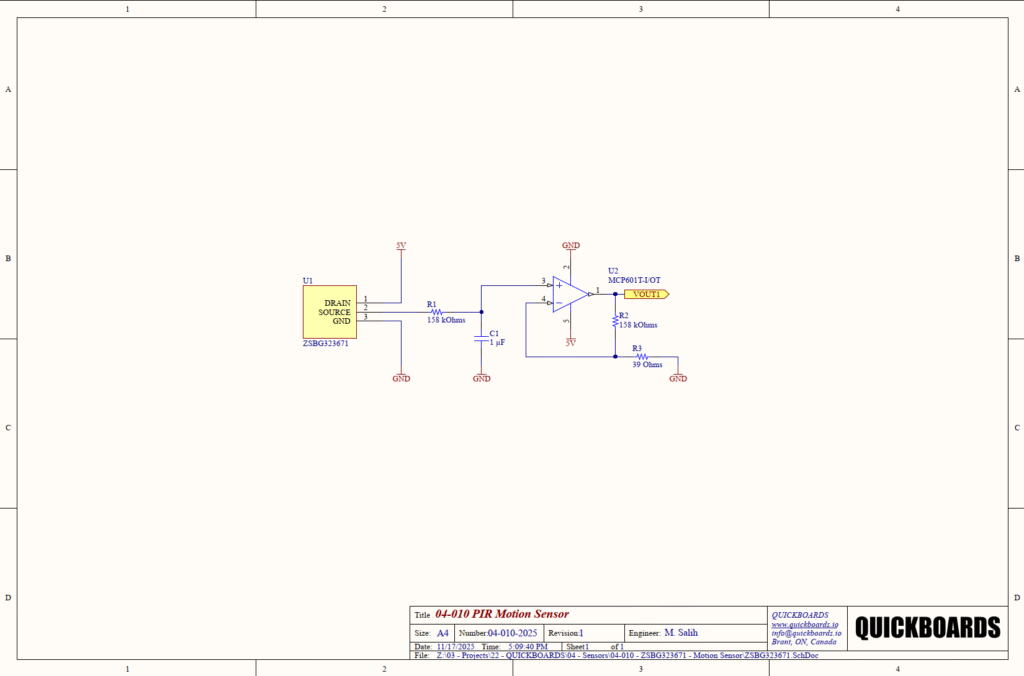
The ZSBG323671 is biased via Pin 1 (Drain) connected to the 5V rail. This defines the operating point of the internal Field Effect Transistor (FET). Pin 2 (Source) acts as the signal output. PIR sensors are high-impedance devices; therefore, the internal FET serves as an impedance converter, allowing the delicate charge generated by the infrared-sensitive ceramic elements to be driven into an external conditioning circuit.
Signal Conditioning: Passive Low-Pass Filtering
The raw signal from the Source (Pin 2) is immediately processed by a first-order passive low-pass filter consisting of R1 (158 kOhms) and C1 (1 uF). PIR signals generated by human movement are extremely low frequency, typically between 0.1 Hz and 5 Hz. The values of R1 and C1 are selected to achieve a cutoff frequency of approximately 1 Hz. This design rationale is twofold: it effectively shunts high-frequency electromagnetic interference (EMI) and power supply noise to ground while preserving the integrity of the slow-moving thermal signature of a moving person. Ceramic X7R capacitors are preferred for C1 due to their high stability and low leakage current, which is paramount in high-impedance analog chains.
Active Amplification Stage
The filtered signal is fed into U2, the MCP601T-I/OT operational amplifier. Because the PIR sensor’s output is so small, a non-inverting amplification topology is used to bring the signal into a range readable by a standard 10-bit or 12-bit ADC. The gain of this stage is defined by the feedback network R2 (158 kOhms) and R3 (39 Ohms). The gain is calculated as $1 + (R2 / R3)$, which in this circuit is approximately 4052.
This exceptionally high gain is necessary to resolve minute temperature changes at a distance. The MCP601 is an excellent choice for this role due to its low input bias current and rail-to-rail output, ensuring that the sensor’s microvolt-level fluctuations are translated accurately to the VOUT1 node. The resistors R2 and R3 must be high-precision (1% or better) to maintain gain consistency and prevent thermal drift from appearing as phantom motion.
Placement & Trace Logic
The physical layout of this block is sensitive. The high-impedance node between U1 Pin 2 and U2 Pin 3 must be kept as short as possible to prevent it from acting as an antenna for 50/60 Hz mains hum or switching noise. Senior engineers should ensure that the PIR sensor is placed away from heat-generating components (like power regulators) and air currents, as localized thermal gradients can induce DC offsets or false triggers. A solid ground plane beneath the signal conditioning components is required to provide a stable return path for the high-gain amplifier.
Implementation Insights
A primary engineering consideration when integrating the ZSBG323671 is the “settling time.” Upon power-up, the PIR sensor and the high-gain amplifier take several seconds (sometimes up to 30 seconds) to stabilize their DC operating points. Firmware must be designed to ignore the VOUT1 signal during this stabilization period to avoid immediate false alarms upon system boot.
A significant challenge with this IC is its sensitivity to environmental noise. Because the gain is so high (over 4000x), even millivolt-level noise on the 5V power rail will be amplified and potentially saturate the output. Using a dedicated low-noise LDO to power the PIR and Op-Amp is highly recommended.
Finally, the optical performance of the system depends heavily on the Fresnel lens used in conjunction with the ZSBG323671. The lens defines the detection patterns and range; without a lens, the sensor has a very limited detection distance. Ensure the sensor is centered within the lens focal point for maximum sensitivity.
Applications
- Intrusion Alarms: Provides the primary detection mechanism for security systems, sensing human presence in restricted areas.
- Automatic Lighting: Enables energy-saving by switching lights on only when occupancy is detected in hallways or offices.
- HVAC Control: Optimizes climate control by adjusting airflow and temperature based on room occupancy.
- Smart Home Appliances: Used in devices that wake up or display information as a user approaches.
Integrating the ZSBG323671 into your design
This modular block provides a validated, high-gain signal chain for the ZSBG323671, eliminating the iterative trial-and-error often required to tune PIR sensitivity. By standardizing the filtering and amplification stages, this design reduces the risk of noise-induced false triggers and ensures a predictable analog output for occupancy sensing. This block allows engineers to skip basic analog front-end research and move directly to implementing complex motion-processing algorithms in firmware.
Skip the tedious research and manual entry. Download the production-ready schematic block for the ZSBG323671 directly from the Quickboards Library.